The document appears to be notes from an Earth Science class. It includes the course outline with various units of study, classroom rules and procedures, lab safety rules, and information about assignments, grading, and setting goals.
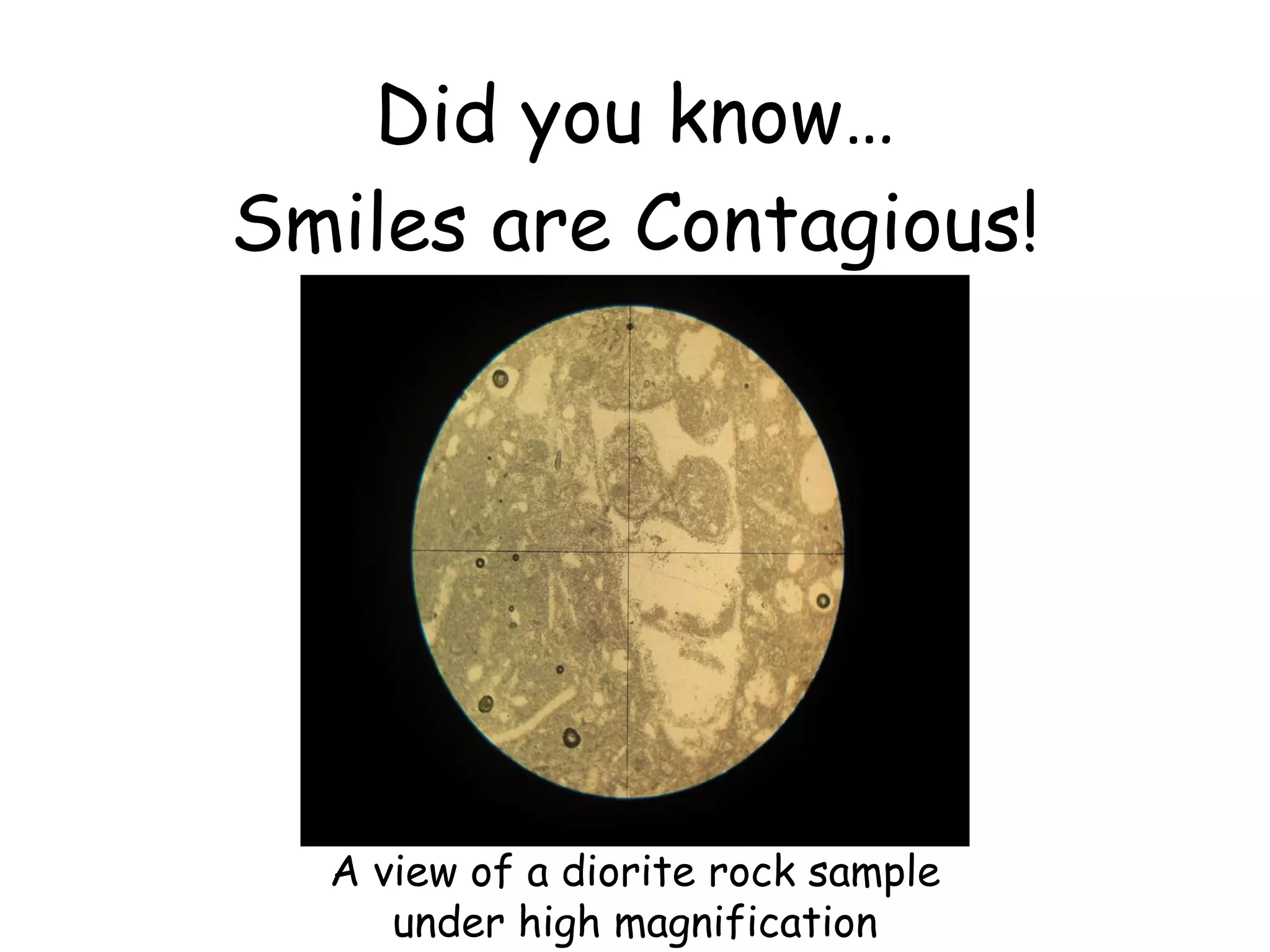
Did you know…Smiles are Contagious! A view of a diorite rock sample under high magnification
11.
12.
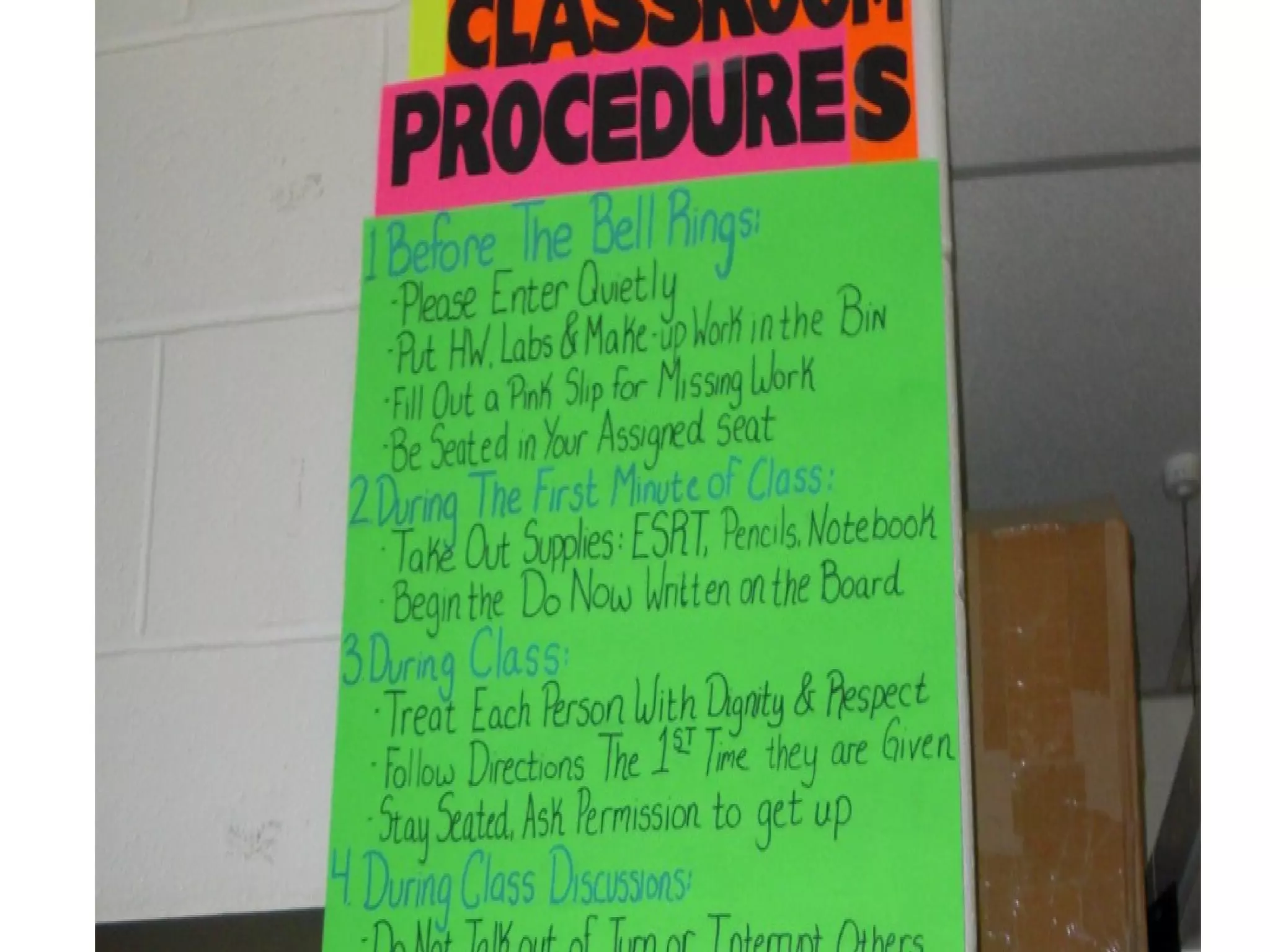
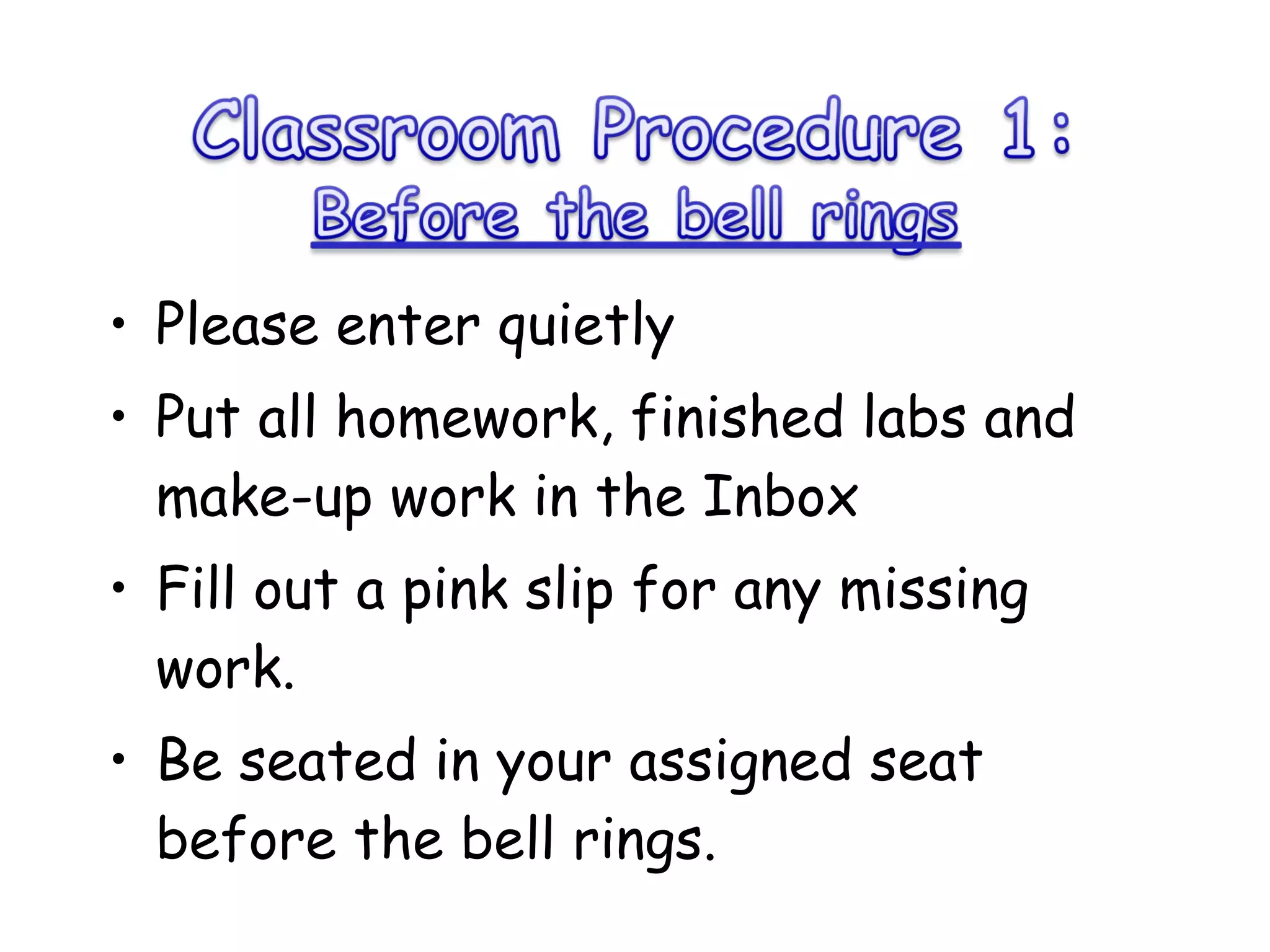
Please enter quietlyPut all homework, finished labs and make-up work in the Inbox Fill out a pink slip for any missing work. Be seated in your assigned seat before the bell rings.
13.
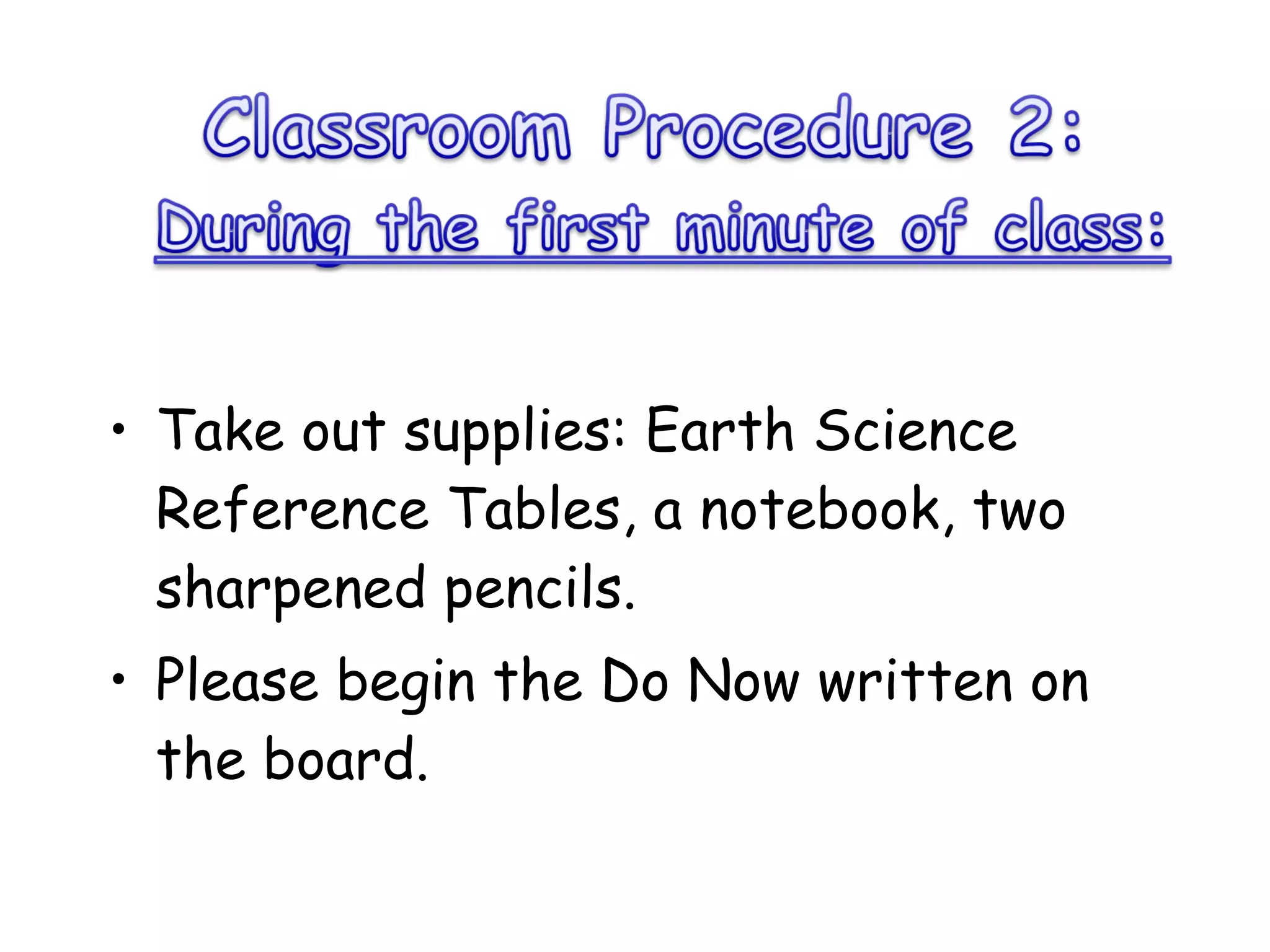
Take out supplies:Earth Science Reference Tables, a notebook, two sharpened pencils. Please begin the Do Now written on the board.
14.
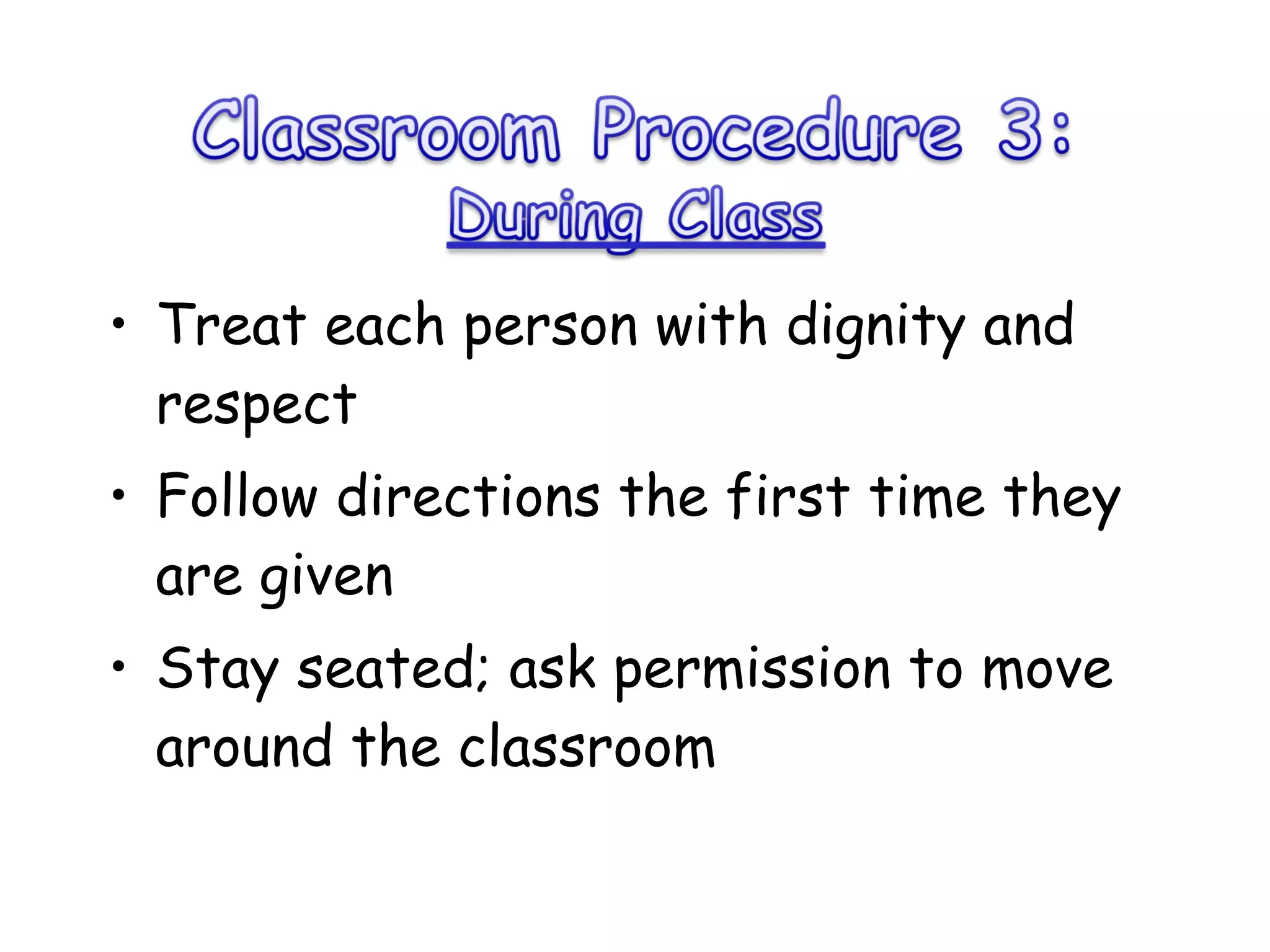
Treat each personwith dignity and respect Follow directions the first time they are given Stay seated; ask permission to move around the classroom
15.
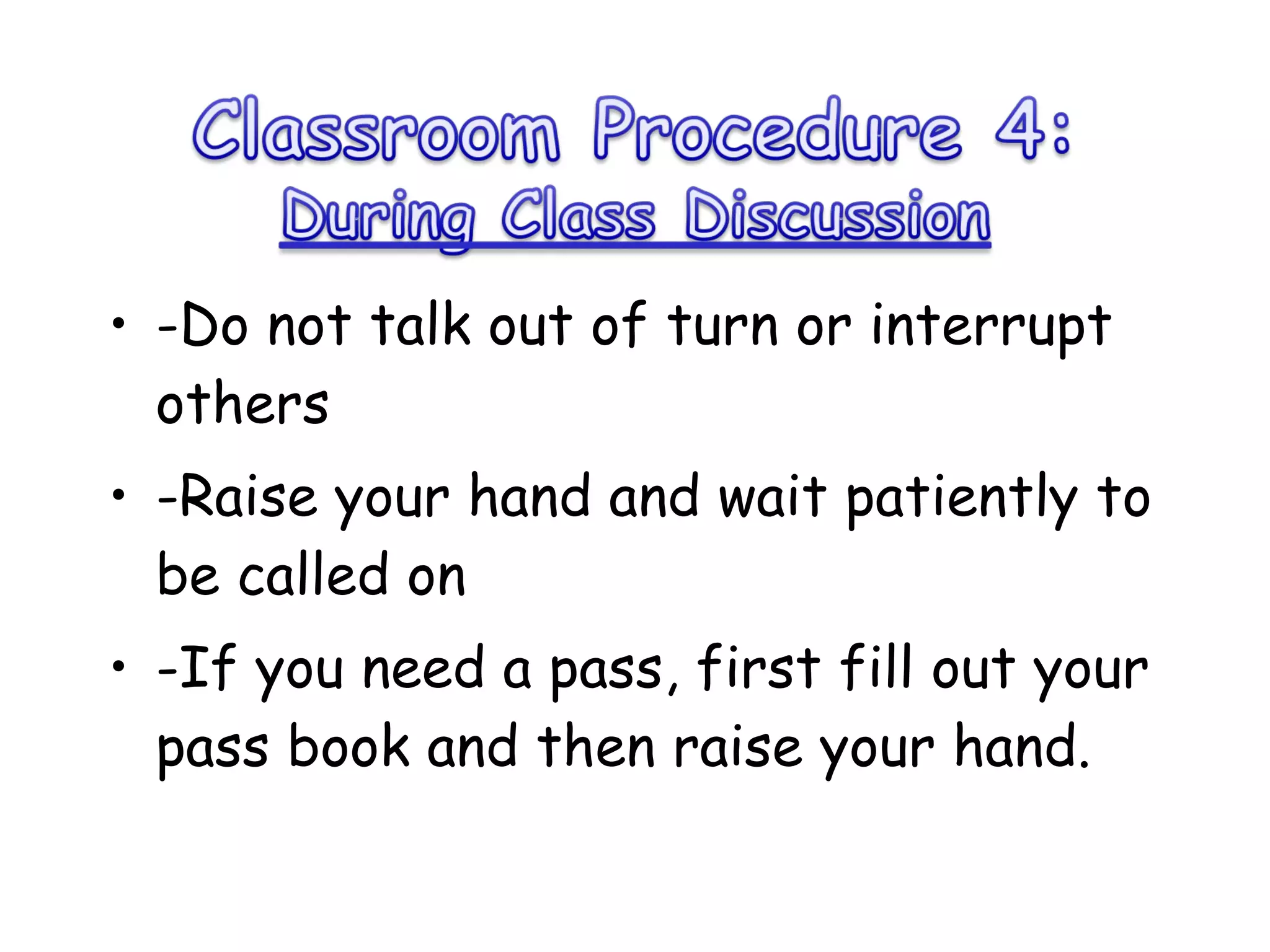
-Do not talkout of turn or interrupt others -Raise your hand and wait patiently to be called on -If you need a pass, first fill out your pass book and then raise your hand.
16.
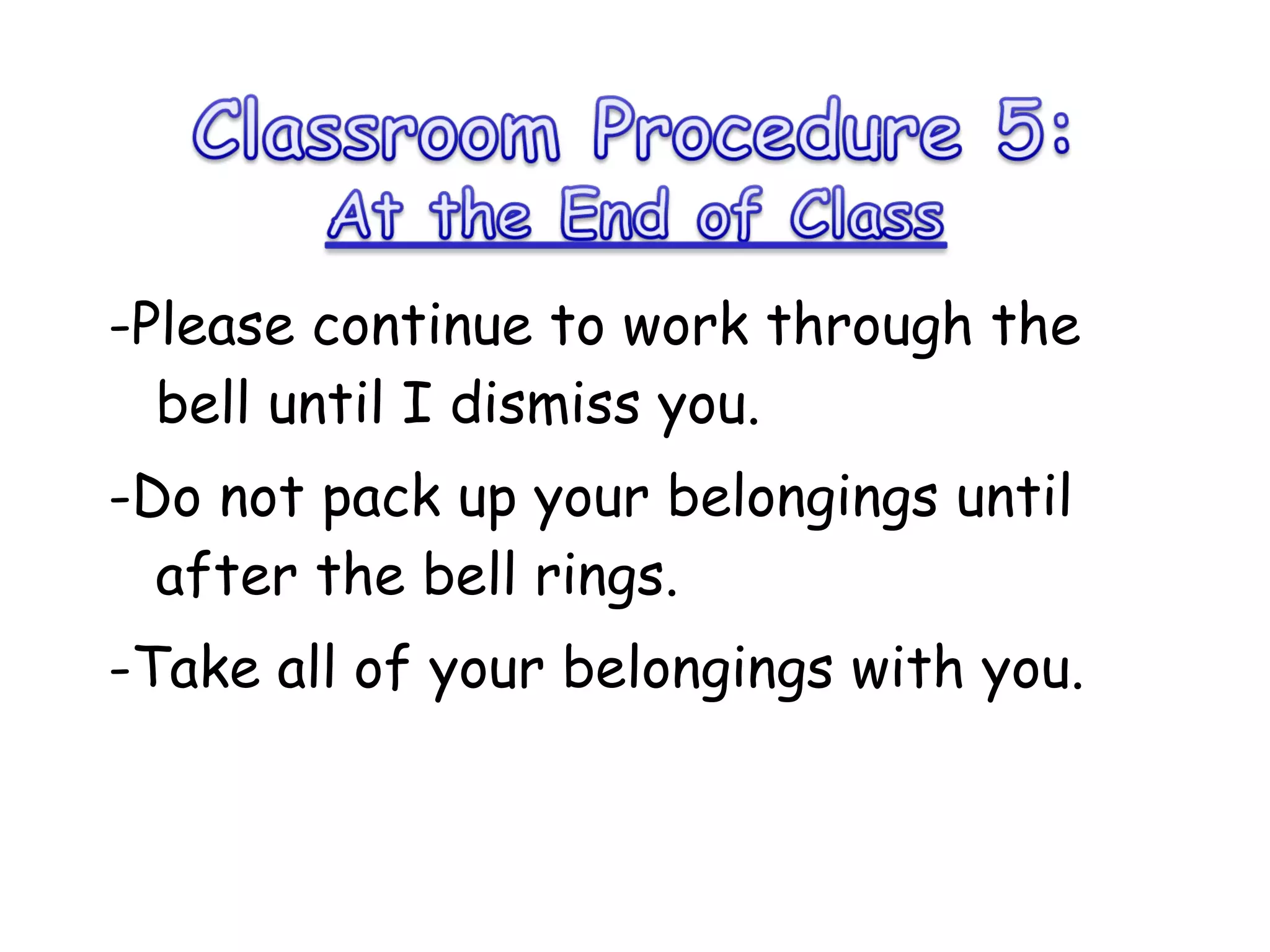
-Please continue towork through the bell until I dismiss you. -Do not pack up your belongings until after the bell rings. -Take all of your belongings with you.
17.
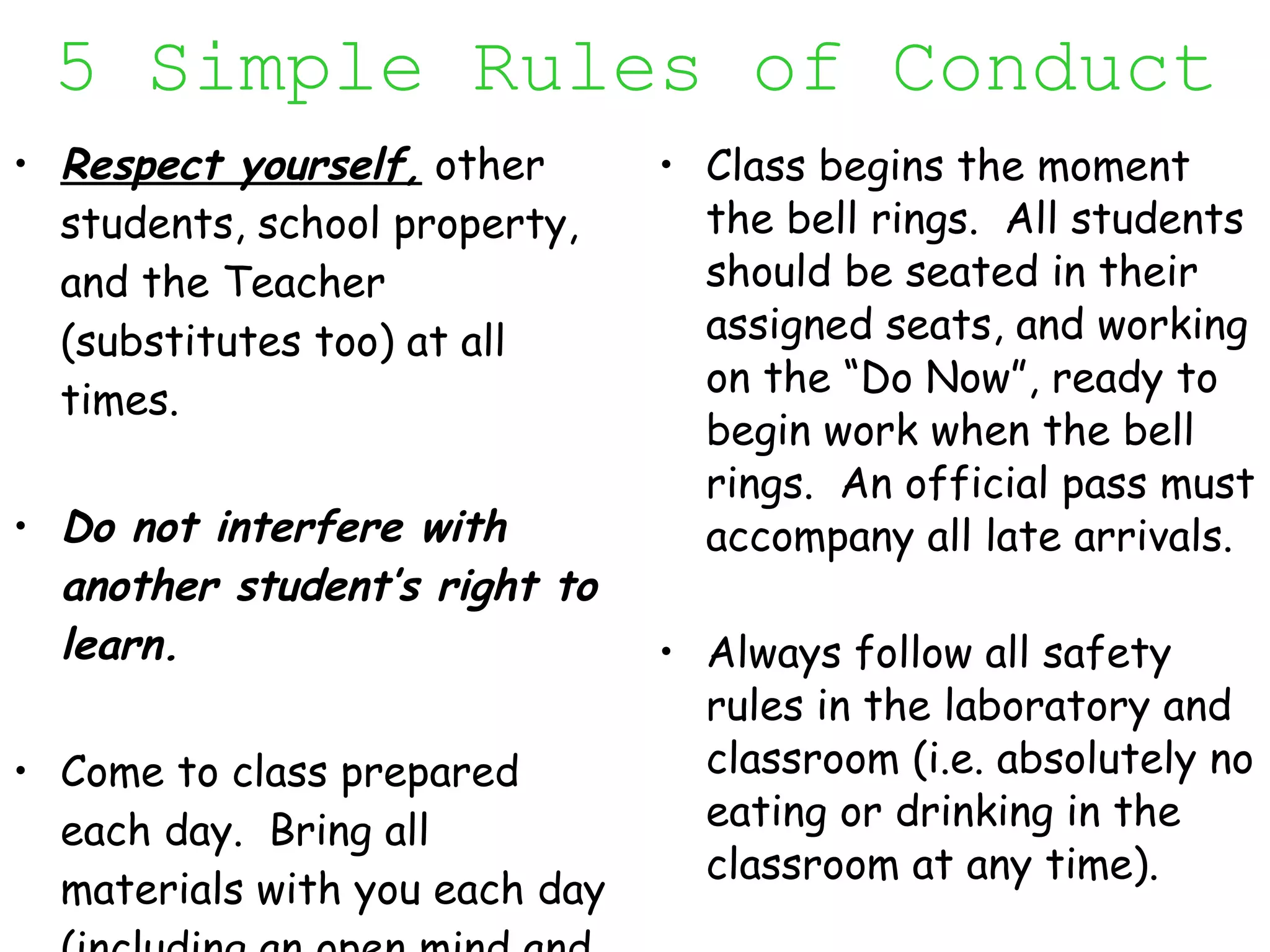
5 Simple Rulesof Conduct Respect yourself, other students, school property, and the Teacher (substitutes too) at all times. Do not interfere with another student’s right to learn. Come to class prepared each day. Bring all materials with you each day (including an open mind and a positive attitude). Class begins the moment the bell rings. All students should be seated in their assigned seats, and working on the “Do Now”, ready to begin work when the bell rings. An official pass must accompany all late arrivals. Always follow all safety rules in the laboratory and classroom (i.e. absolutely no eating or drinking in the classroom at any time).
18.
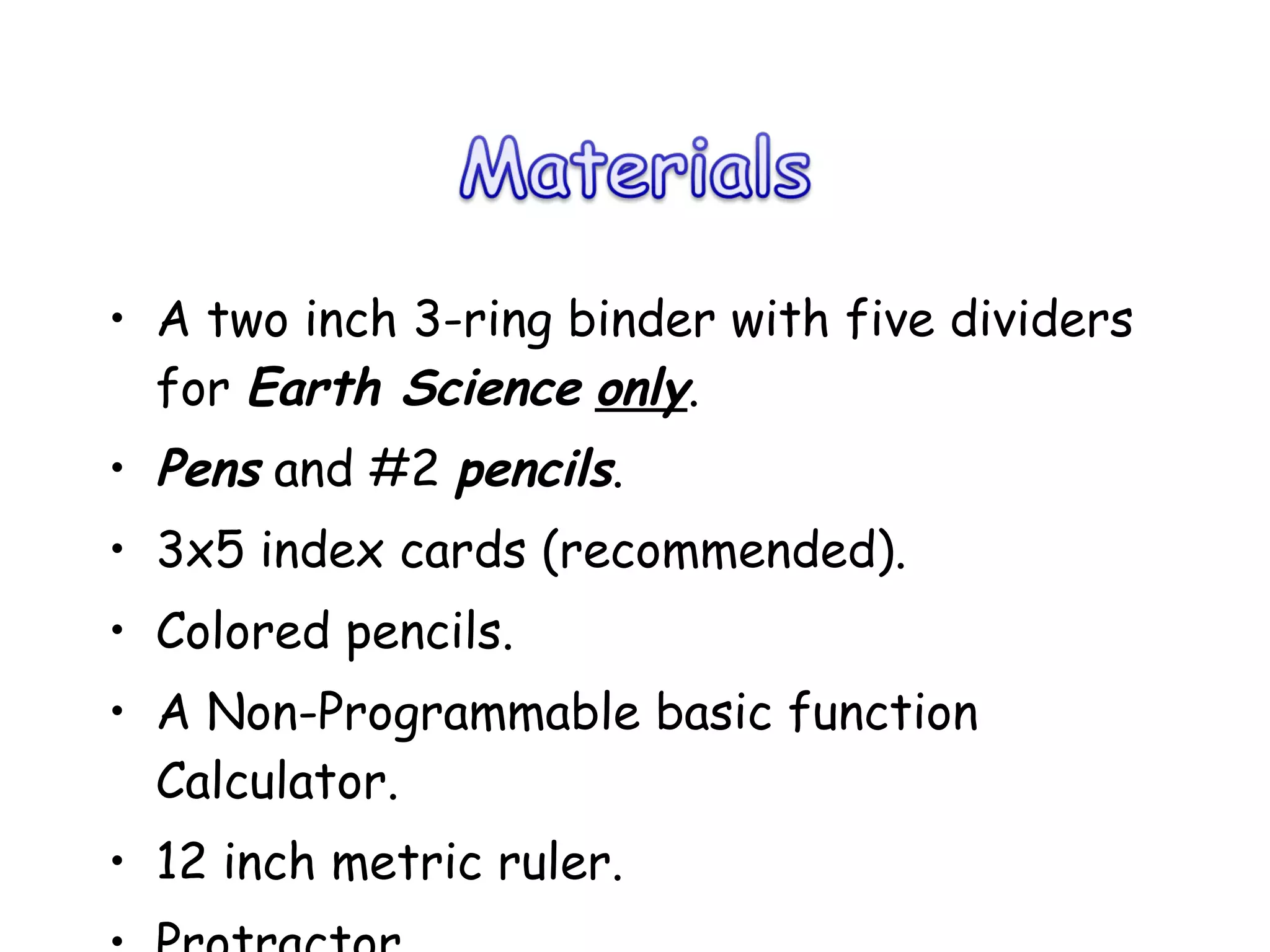
A two inch3-ring binder with five dividers for Earth Science only . Pens and #2 pencils . 3x5 index cards (recommended). Colored pencils. A Non-Programmable basic function Calculator. 12 inch metric ruler. Protractor Highlighter
19.
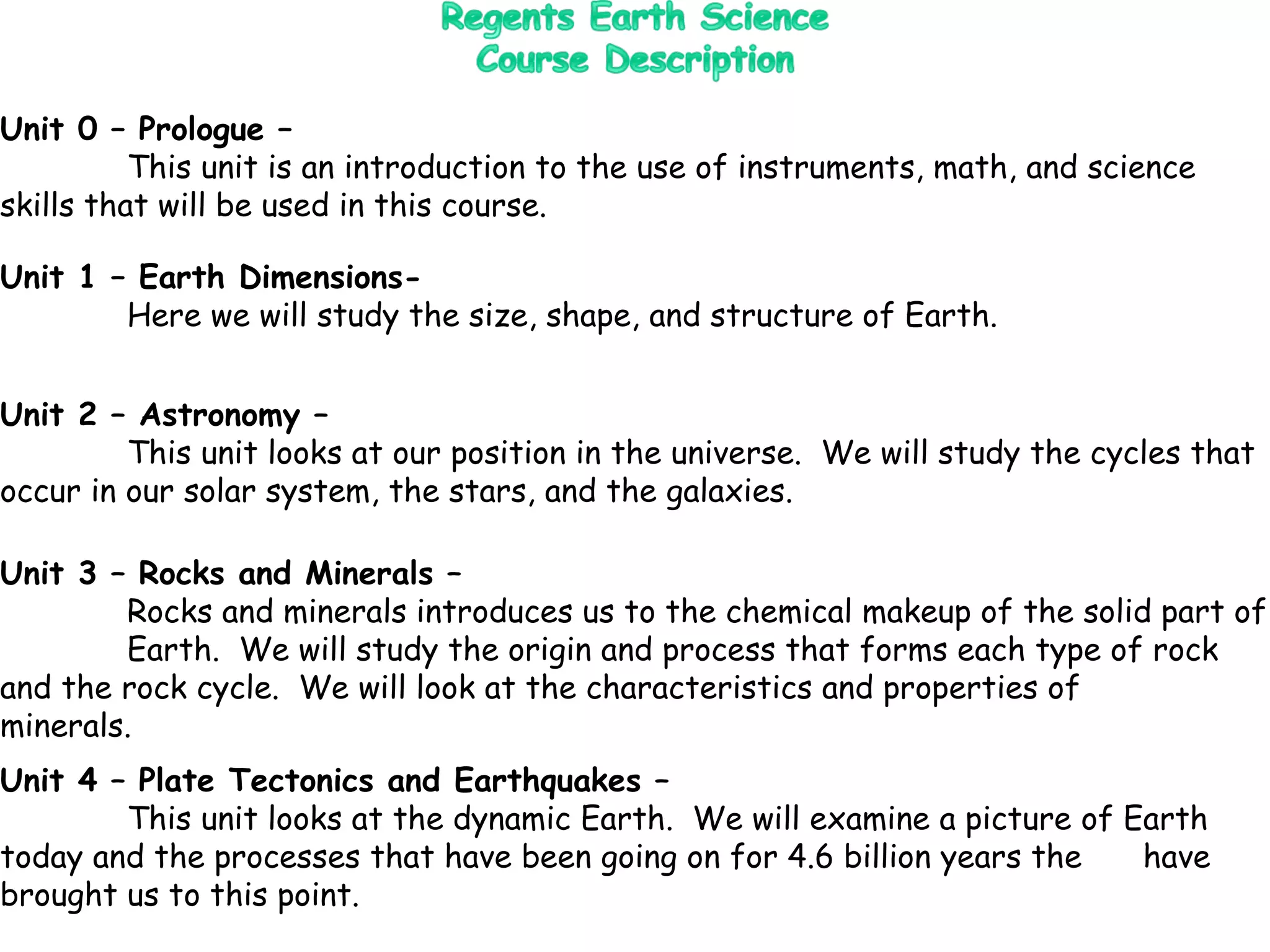
Unit 0 –Prologue – This unit is an introduction to the use of instruments, math, and science skills that will be used in this course. Unit 1 – Earth Dimensions- Here we will study the size, shape, and structure of Earth. Unit 3 – Rocks and Minerals – Rocks and minerals introduces us to the chemical makeup of the solid part of Earth. We will study the origin and process that forms each type of rock and the rock cycle. We will look at the characteristics and properties of minerals. Unit 4 – Plate Tectonics and Earthquakes – This unit looks at the dynamic Earth. We will examine a picture of Earth today and the processes that have been going on for 4.6 billion years the have brought us to this point. Unit 2 – Astronomy – This unit looks at our position in the universe. We will study the cycles that occur in our solar system, the stars, and the galaxies.
20.
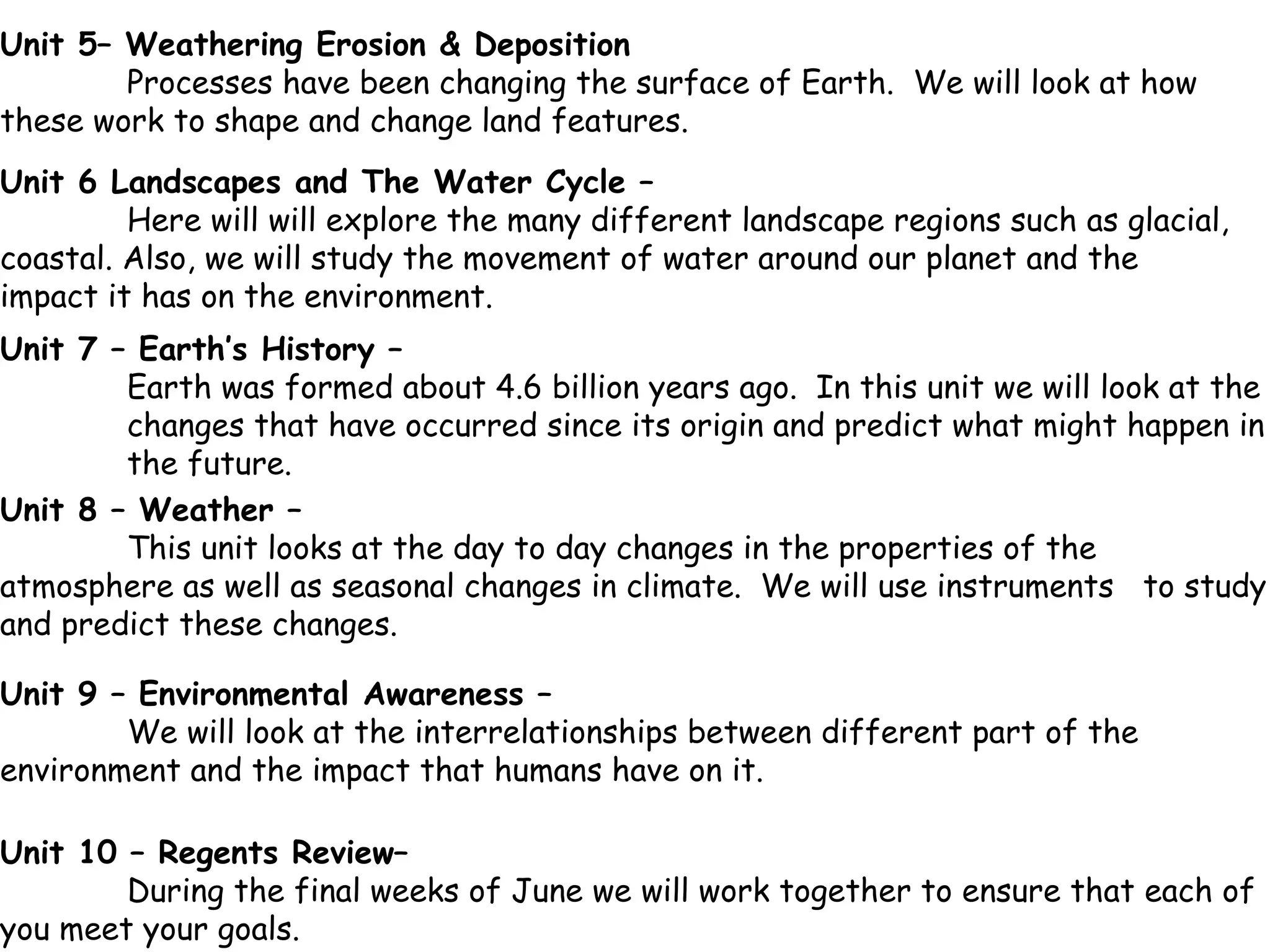
Unit 7 –Earth’s History – Earth was formed about 4.6 billion years ago. In this unit we will look at the changes that have occurred since its origin and predict what might happen in the future. Unit 8 – Weather – This unit looks at the day to day changes in the properties of the atmosphere as well as seasonal changes in climate. We will use instruments to study and predict these changes. Unit 6 Landscapes and The Water Cycle – Here will will explore the many different landscape regions such as glacial, coastal. Also, we will study the movement of water around our planet and the impact it has on the environment. Unit 9 – Environmental Awareness – We will look at the interrelationships between different part of the environment and the impact that humans have on it. Unit 10 – Regents Review– During the final weeks of June we will work together to ensure that each of you meet your goals. Unit 5– Weathering Erosion & Deposition Processes have been changing the surface of Earth. We will look at how these work to shape and change land features.
21.
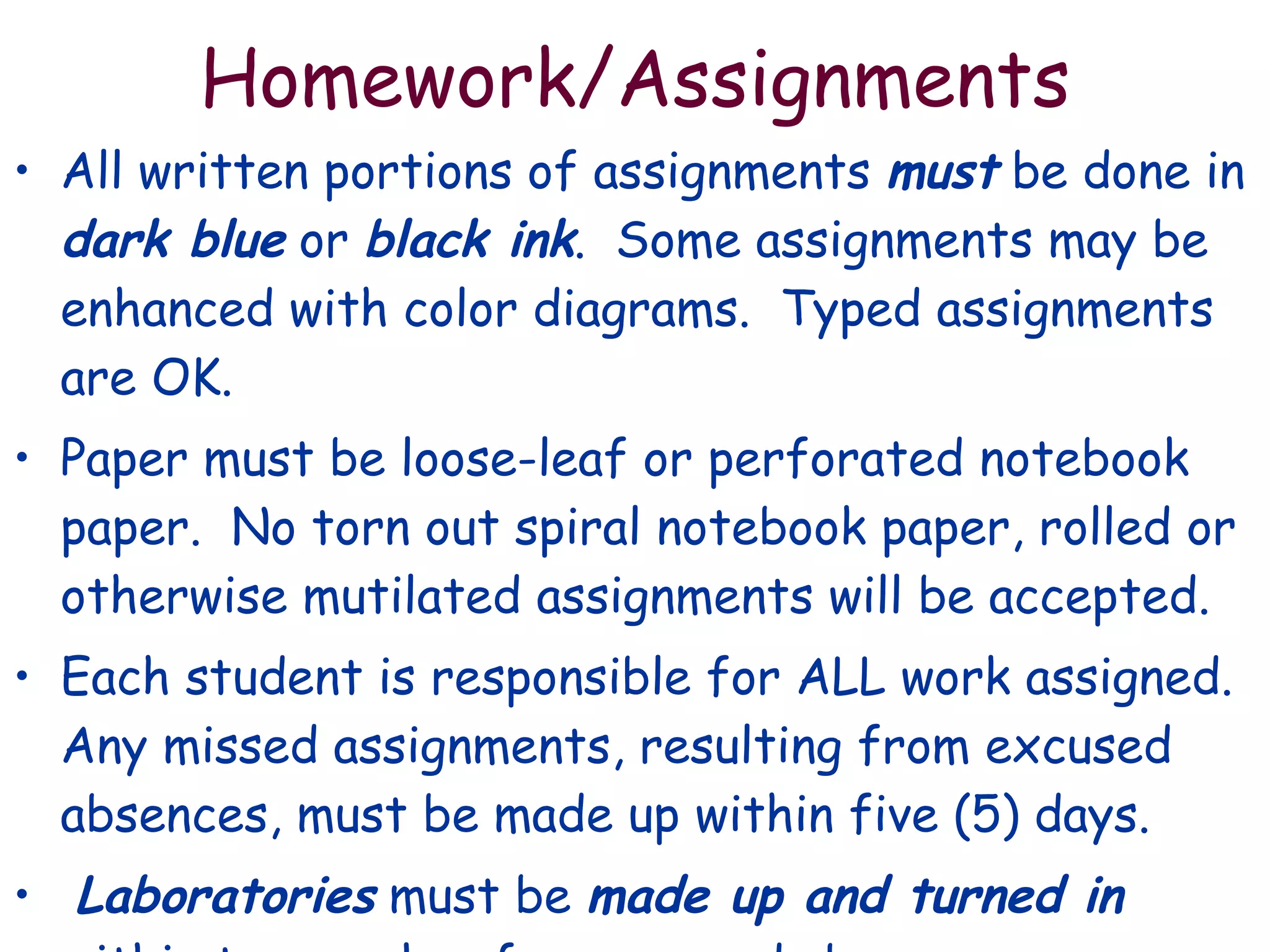
Homework/Assignments All writtenportions of assignments must be done in dark blue or black ink . Some assignments may be enhanced with color diagrams. Typed assignments are OK. Paper must be loose-leaf or perforated notebook paper. No torn out spiral notebook paper, rolled or otherwise mutilated assignments will be accepted. Each student is responsible for ALL work assigned. Any missed assignments, resulting from excused absences, must be made up within five (5) days. Laboratories must be made up and turned in within two weeks of an excused absence.
22.
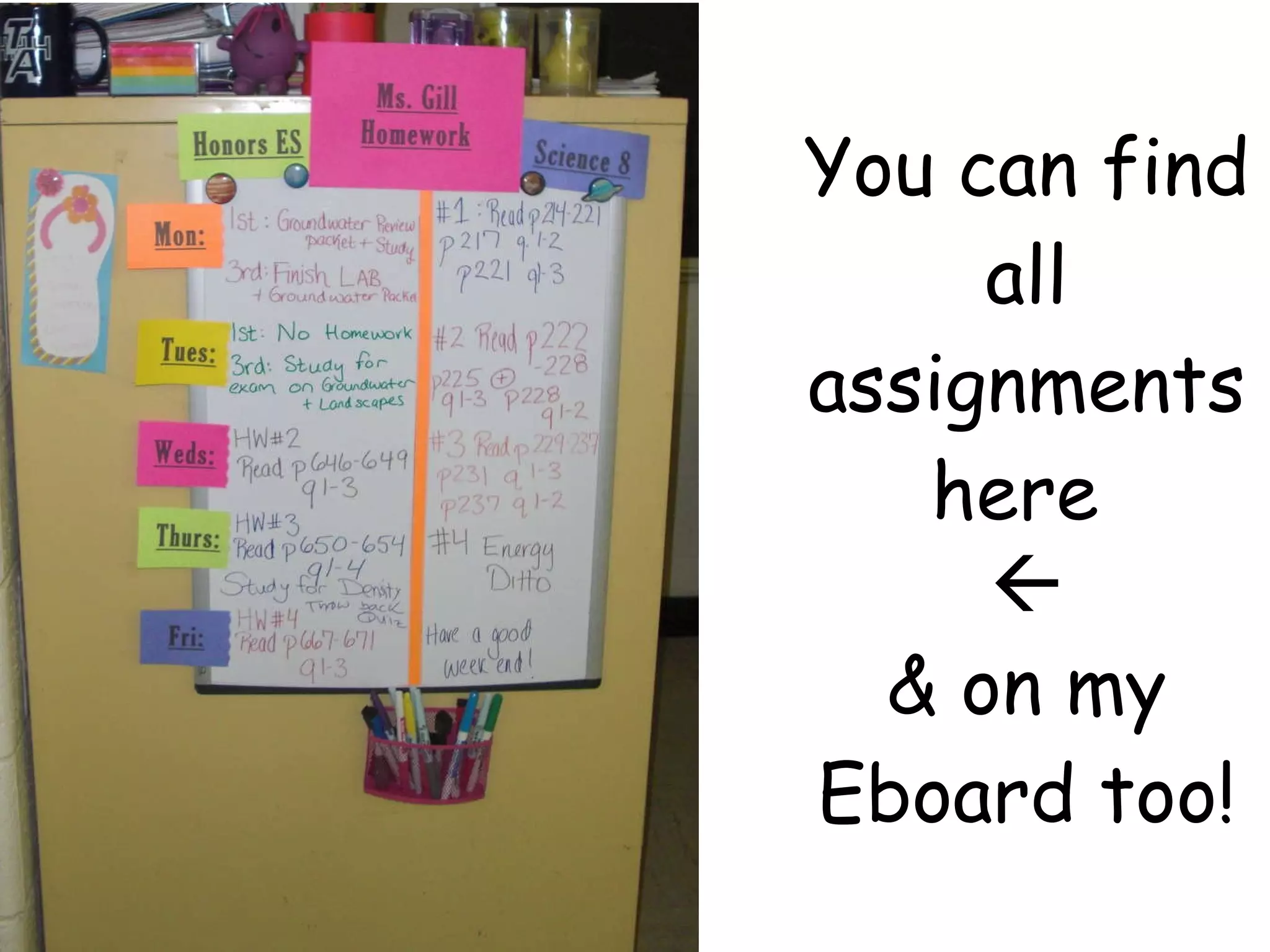
You can findall assignments here & on my Eboard too!
23.
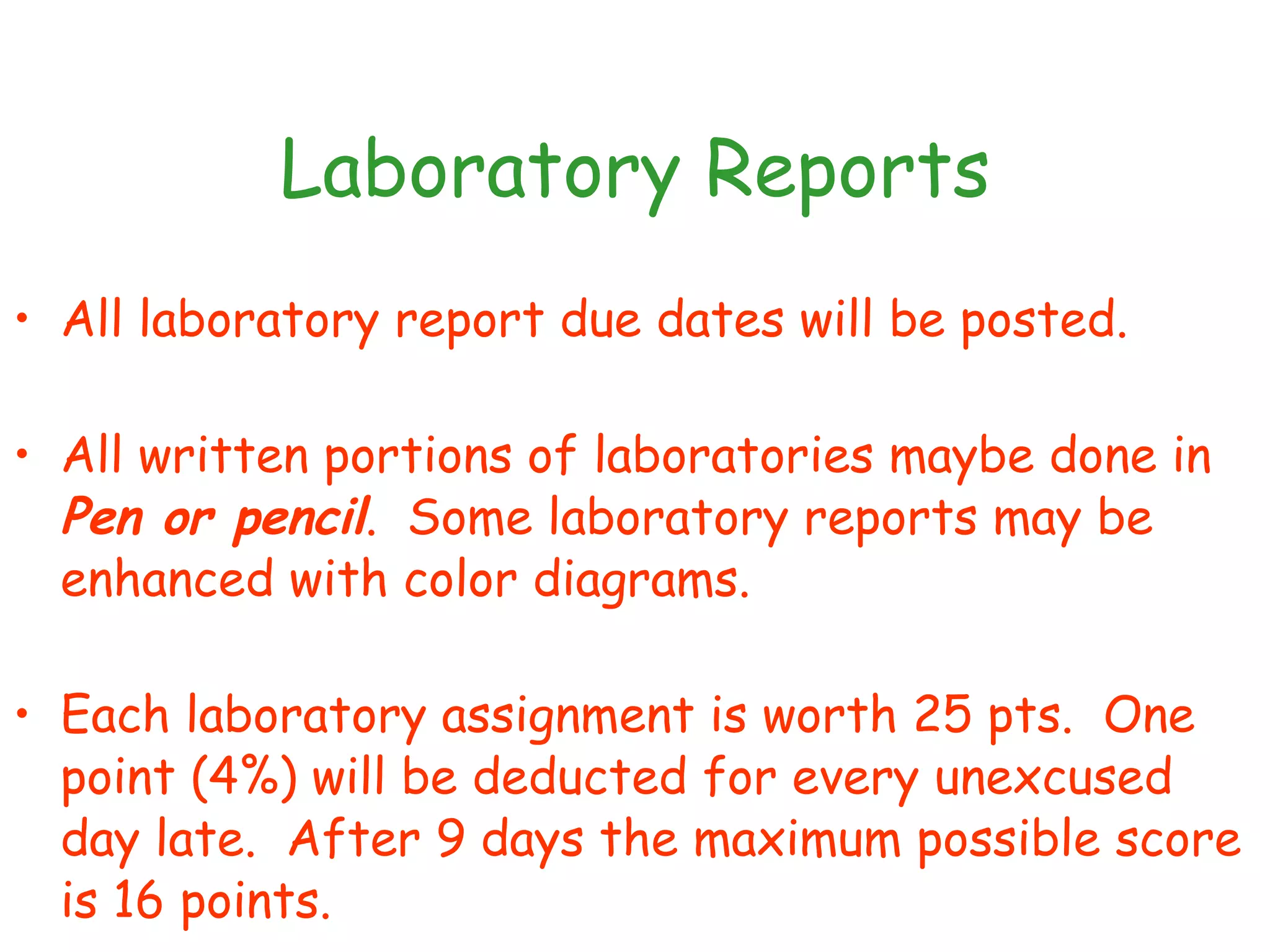
Laboratory Reports Alllaboratory report due dates will be posted. All written portions of laboratories maybe done in Pen or pencil . Some laboratory reports may be enhanced with color diagrams. Each laboratory assignment is worth 25 pts. One point (4%) will be deducted for every unexcused day late. After 9 days the maximum possible score is 16 points.
Also on mycart you will find the Make-Up work bin, therefore when absent, you can get any handouts that you missed. Most handouts will also be available on my Eboard.
26.
Extra Help Iwill be available for extra help every Tuesday & Wednesday afternoons from 2:45 to 3:45 PM. I will also be available Thursday mornings from 7:15-7:45 AM. Please use this time for questions or help before you feel like you are in trouble. If you cannot meet during the regular extra help times we will work out another time, just speak to me. Remember, there is no such thing as a dumb question!
27.
Grading Policies Tests(50%): about 2-3 per quarter, approximately 100 points each Quizzes (20%): about 4 per quarter, approximately 25-30 points each Labs (25%): about 10 per quarter worth 25-50 points per lab depending on scope of lab. Late labs will be penalized 10% per day, and pink slips will be completed and filed. Homework (5%): 10 points per fully completed and on time assignment. Late assignments will only be accepted if due to an excused absence.
28.
Weekly Quizzes –A ten to fifteen minute short answer/multiple choice quiz designed to help assess student’s comprehension of recent class work before proceeding to a new subject. Topic Examinations – A two-period test comprised of multiple choice, essay and short answer questions. Homework Assignments – Nightly reading and short answer assignments designed to either review the prior day’s lesson or begin exploring a new subject. Laboratory Reports – Will be assessed on completeness and accuracy. Progress reports will be available on Infinite Campus Portal which will always be kept open.
29.
The grading policyoutlined above applies to the student’s quarterly grades. The final grade will be an average of the four quarterly grades and the Earth Science Regents. The Earth Science Regents Examination counts as 20% of the student’s final grade.
30.
General Laboratory SafetyRules Read all instructions before proceeding and follow all instructions given by the teacher. Report any accidents or unsafe behavior. Wear appropriate protective clothing or gear for that day’s particular activity (i.e. goggles, gloves, long sleeves). Tie back long hair or loose fitting clothing. No eating, drinking or gum chewing in the classroom/laboratory. Do only the experiments assigned by or approved by the teacher.
31.
Never substitute materialsor procedures called for in written or verbal instructions. No fooling around or horseplay in the laboratory/classroom at any time. Learn the locations of fire extinguishers, fire blankets, safety shower, eyewash, and know how to use them. Treat all chemicals as poisonous and as a personal health hazard unless otherwise instructed. No sitting or standing on laboratory tables at any time. Conduct yourself in a responsible manner at all times.
Now lets discussyour goals… To achieve something in life… you must plan to achieve it so we will begin by setting goals We will revisit this exercise several times through out the year to reflect and revise our goals.